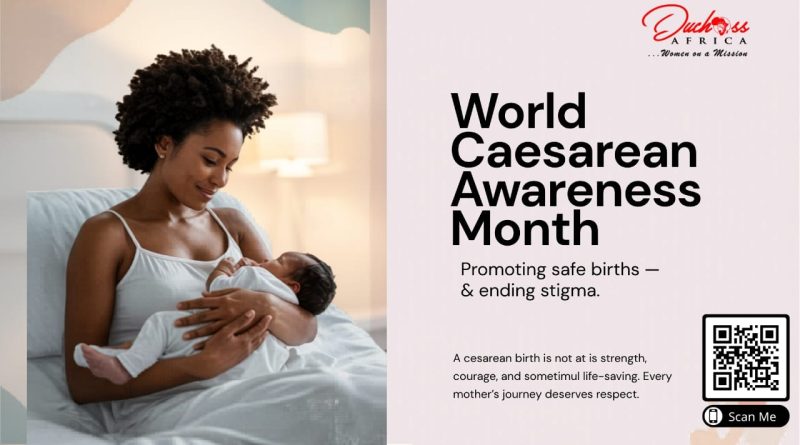
World Caesarean Awareness Month: Promoting Safe Births and Ending Stigma
The month of April is globally recognized as World Caesarean Awareness Month, a dedicated period for raising awareness about Caesarean delivery and maternal health. It provides an important opportunity to educate society, correct long-standing misconceptions, and deepen public understanding of Caesarean section as a safe, effective, and often life-saving method of childbirth when medically indicated. It also serves as a reminder that maternal health decisions should always be guided by medical evidence, not stigma or misinformation.
Childbirth generally takes place through two primary methods, vaginal delivery and Caesarean section. Both are established medical approaches that exist for one central purpose, which is to ensure the safety and well-being of both mother and baby. In modern obstetric care, the focus is not on how a baby is delivered, but on achieving a safe outcome for both lives involved. Every delivery that preserves life and health is a success, regardless of the method used.
Despite significant advancements in healthcare, Caesarean delivery is still surrounded by stigma in many communities. It is often wrongly labelled as a less natural or weaker form of childbirth, and in some cultural settings it is associated with fear, shame, or misunderstanding. These perceptions can place unnecessary pressure on women and sometimes discourage them from accepting medically necessary procedures. Such misconceptions are not only inaccurate, but they can also endanger lives by delaying timely medical intervention.
In reality, a Caesarean section is a surgical procedure performed when vaginal delivery may pose risks to the mother, the baby, or both. It is not a sign of weakness or failure, but a carefully considered medical decision that prioritizes safety. Across the world, it has played a critical role in reducing maternal and infant mortality and remains one of the most important interventions in modern obstetric care.
There are several medical reasons why a Caesarean delivery may be recommended. One of the most common is prolonged or obstructed labour, where the cervix fails to dilate adequately despite strong and continuous contractions. In such cases, labour may continue for many hours without progress, leading to exhaustion for the mother and increasing the risk of complications for both mother and baby.
Another important reason is fetal distress, which occurs when the baby shows signs of reduced oxygen supply. This is often detected through abnormal heart rate patterns during labour monitoring. In such situations, immediate delivery becomes necessary to prevent harm. Caesarean section is also recommended when the baby is in an abnormal position, such as breech presentation where the feet or buttocks come first, or transverse lie where the baby is positioned sideways, making safe vaginal delivery difficult or impossible.
Other medical indications include placenta previa, a condition where the placenta covers or blocks the birth canal, and maternal health conditions such as severe hypertension or infections that make vaginal delivery unsafe. In cases of multiple pregnancies or previous uterine surgeries, doctors may also recommend Caesarean delivery to ensure a controlled and safer birth process that reduces potential risks.
It is important to understand that labour does not always progress in a predictable or uniform way. Even when contractions are strong, the cervix may fail to dilate, or the baby may not descend properly through the birth canal. When this happens, continuing labour can increase the risk of complications rather than improve the outcome. In such circumstances, Caesarean delivery becomes the safest and most responsible option to protect both mother and child.
Much of the fear and stigma surrounding Caesarean section is driven by misinformation, cultural beliefs, and limited access to accurate health education. However, with consistent awareness, open conversations, and improved understanding, these misconceptions can be corrected. Caesarean delivery should be recognized for what it truly is, a modern, safe, and essential medical advancement that ensures positive birth outcomes when complications arise.
As we observe World Caesarean Awareness Month in April, it is important to reaffirm a simple and powerful truth. There is no superior or inferior way to give birth. Every safe delivery is a victory, and what matters most is that both mother and baby are healthy, safe, and given the best possible start to life.
In line with this awareness, we pause to honour the mothers at the centre of every Caesarean story, the women whose strength is often unseen yet deeply remarkable in every sense. A Caesarean delivery is not only a medical procedure, but also a journey that requires courage, trust, and resilience from a mother who places her life and her baby’s life in the hands of medical care when necessary.
Today, we celebrate these mothers with deep respect and gratitude. You are strong beyond measure. You are brave beyond words. You are courageous in ways that cannot always be fully expressed. You carried life within you, endured surgery, and stepped into motherhood with quiet strength and remarkable resilience. In a matter of weeks, you begin feeding, healing, moving, and returning to daily life while still carrying the responsibility of new life in your arms.
You are not less for how you gave birth. You are powerful because you did. Every scar tells a story of survival, love, and strength. Every recovery is a testament to endurance and grace.
In this awareness, Duchess Africa stands in recognition of every mother whose journey to childbirth took this path. We honour them not as exceptions, but as women whose experiences reflect strength, dignity, and life-saving resilience.
In celebrating them, we affirm once more that every safe delivery is a victory and every mother deserves dignity, respect, and honour, regardless of how her child was brought into the world.